
“See, I am doing a new thing! Now it springs up; do you not perceive it?”
- Isaiah 43:19a (NIV)
Nearly two years have passed since I was assigned to serve East Ohio and West Ohio together as one episcopal area. During that time, I have been deeply grateful for the growing cooperation, shared ministries and relationships that have developed across our two annual conferences.
As we continue the journey toward One Ohio, many faithful questions remain. What will this mean for our churches? How will it strengthen our mission? What opportunities and challenges will it bring?
These questions deserve clear information, open conversation, and careful spiritual discernment.
In the coming months, the Ohio Episcopal Area Task Team will continue to share accurate information and emerging proposals as transparently as possible. We will continue listening to clergy, laity, congregations, and leaders across both conferences, seeking to understand not only what may be organizationally possible, but also what will best strengthen the mission of Jesus Christ throughout Ohio.
In 2027, the East Ohio and West Ohio Annual Conferences will consider and vote on proposals that emerge from this process. That will be an important milestone, but it is not the mission itself.
Our deeper question is:
What kind of Church is God calling us to become?
Our shared Five Pillars – Building Relationships; Shared Mission; Discipleship; Multiplication; and Emerging Leaders – are intended to help us keep that larger mission before us.
We must continually ask whether our structures, leadership, and resources are helping local churches become stronger and more fruitful; whether new disciples and faith communities are emerging; whether leaders are being equipped and renewed; and whether our neighbors are encountering Jesus Christ through our friendship, service, compassion and witness.
For me, this is the heart of the One Ohio journey.
It is not simply about bringing two conferences together. It is about discovering how we can serve Christ’s mission more faithfully together. That is why I am asking all of us to pray.
Let us listen to those who are hopeful and to those who have concerns. Let us listen across generations, cultures, communities, and theological perspectives. Beneath all these voices, let us listen for the movement of the Holy Spirit.
I will continue to listen, ask questions, and seek with you the clearest and most faithful path toward the future God is opening before us.
I believe our future can be bright – not simply because we find the right structure, but because we remain rooted in Christ, open to the Spirit, attentive to our neighbors and willing to walk together.
Isaiah reminds us that God is already at work:
“See, I am doing a new thing!”
May we have eyes to perceive it, ears to hear one another, hearts open to the Spirit, and courage to walk together into God’s new day.
Please pray with me for our Task Team, our leaders, our congregations, our 2027 Annual Conferences, and the whole United Methodist witness across Ohio. May everything we discern and decide bear good fruit for the mission of Jesus Christ.
A conference lay leader is the elected leader of conference laity and has the responsibility of fostering awareness of the role of the laity both within the congregation and through their ministries in the home, workplace, community, and world in achieving the mission of the Church. The conference lay leader also enables and supports lay participation in the planning and decision-making processes of the annual conference, district, and local church in cooperation with the bishop, district superintendents, and pastors.
Leslie Hall, West Ohio Conference Co-Lay Leader

It is my honor and privilege to be your Co-Lay Leader. The story of Philip and the Ethiopian Eunuch, Acts 8:26-40 speaks to me, specifically verses 30-31. Inspiring, partnering, serving and leading, are my responses to God’s call on my life and my work in the church. I’m a member of New Vision, The Great Miami River District, Cincinnati, OH serving as a Certified Lay Speaker, as a member of The Breakthrough Board and several committees.
Born and raised in Wilmington, Delaware, I was an active member of the Historic Ezion-Mt. Carmel UMC. From an early age I was encouraged to know, worship and serve the Lord, and I have passionately used my gifts and talents in the church. Additionally, I serve on DCOM, Lay Servant Ministry Team and Racial Justice Task Force of The Great Miami River District and was the former District Co-Lay Leader. My Conference commitments have been West Ohio Conference Episcopacy Committee and District Realignment Team. Prior to her passing, I was blessed to have shared 39 years of marriage with my wife, Angelene Jamison-Hall, PhD. Emerita, University of Cincinnati, College of Arts and Sciences, Africana Studies. Together, we have one grown daughter.
Christina Albrecht, West Ohio Conference Co-Lay Leader

I am humbled to serve as one of your co-lay leaders. I believe that it is an exciting time in West Ohio and look forward to all that is to come. I am a member and on staff at Peace United Methodist in Pickerington, Ohio as the Director of Outreach and Communications. I am passionate about ensuring the church is incarnational, not just for those currently connected, but for generations to come. I grew up in the United Methodist Church and discerned my call as laity through the West Ohio Conference internship program. Since then, I have served various congregations in the Olentangy River District as youth and family director. I’ve served on the conference Safe Sanctuaries team, College ministry team, Leadership Development Team and led the Emerging Generations ministry team prior to becoming co-lay leader.
My husband, Josh and I live in Canal Winchester with our son and two fur children. We love building community with neighbors, exploring outdoors, and celebrating the joys of everyday life. This is my prayer for West Ohio, that our churches may be able to celebrate what God is already doing and lean into what is yet to come.

The 2016 General Conference lifted ¶349 and affirmed the need for a process for reflecting on one’s effectiveness in ministry and discerning God’s call for serving with excellence in whatever capacity one’s calling leads. Since February 2018, a 15-person Planning Team consisting of members of the West Ohio Conference Laity, Board of Ordained Ministry, the Appointive Cabinet, and the Office of Ministry have been developing the process for caring for this work. It is our intent to affirm one’s body of work in ministry and to create a comprehensive plan for continued excellence. Our team created a name for this work, the Reflecting, Equipping, and Flourishing Process (REF).
The scriptural foundation for this process comes from James 1:22-25 – “Do not merely listen to the word, and so deceive yourselves. Do what it says. Anyone who listens to the word but does not do what it says is like someone who looks at his face in a mirror and, after looking at himself, goes away and immediately forgets what he looks like. But whoever looks intently into the perfect law that gives freedom and continues in it – not forgetting what they have heard but doing it – they will be blessed in what they do.”
The first group to participate in the REF Process did so in September 2019 at the Nationwide Conference Center in Lewis Center, OH. The planning team listened intently to the feedback from the first group before preparing to launch the full process in 2022.
This Event will include exploration of one’s Emotional Quotient, learning about EQ Coaching, time set aside for spiritual reflection, and opportunities to connect with fellow leaders. Scientific data and research have shown that ministry cycles shift in eight-year increments, so all participants in REF will have been in ministry for at least eight years and will begin this journey together. After the Event, there will be a six-month period of self-reflection, coaching, and personal and professional development. There will also be special consideration given for those who are looking for paths of re-tooling, returning to school, and exploring creative paths for ministry.
The full launch will take place in February 2022.

2026 Ohio Vision Statement
In 2026, the Ohio Episcopal Area moves forward in collaboration, discipleship, multiplication, leadership development, and global mission – building a unified Spirit-led movement rooted in abundance, trust, and the Gospel of Jesus Christ. We commit ourselves to prayer, partnership, and courageous action as we form “One Ohio” for the sake of God’s mission in the world.
Five Strategic Pillars
The Five Pillars listed below emerged from conversations Bishop Hee-Soo Jung has had during his visits to more than 250 congregations across the Ohio Episcopal Area. In those conversations clergy and laity shared deep and faithful longings to grow in discipleship, to reach new people for Christ, to pass on the faith to the next generation, and to live in meaningful relationship and mission with their communities and the wider world.
The Five Pillars are not a program or a set of guarantees. Rather, they offer a shared vision and spiritual framework to guide our life together as “One Ohio” – rooted in the Gospel of Jesus Christ, shaped by trust, and attentive to the leading of the Holy Spirit.
Pillar 1: Building Relationships
Pillar 2: Shared Mission
Pillar 3: Discipleship
Pillar 4: Multiplication
Pillar 5: Emerging Leaders
Download the Five Pillars document. (1-page)
Download the Five Pillars guiding questions and shared discernment document. (3-page)
The Leadership Development Team of the West Ohio Conference of the United Methodist Church is excited to introduce the new Framework for Leadership, a spiritually grounded and mission-driven model designed to guide leaders in their journey of personal growth, relational leadership, and community impact.
Rooted in Wesleyan values and responsive to the evolving needs of our congregations and ministries, this framework offers a holistic approach to leadership—one that nurtures the heart, equips the mind, and strengthens the hands of those called to serve.
Three Pillars of Leadership
The Framework for Leadership is built on three interconnected pillars:
Leading Self
Cultivating spiritual depth, emotional intelligence, and personal integrity. This pillar encourages leaders to:
- Deepen their relationship with God
- Embrace lifelong learning and self-reflection
- Live out their calling with authenticity and resilience
Leading Others
Fostering healthy relationships, collaborative teams, and inclusive ministry. Leaders are called to:
- Empower and equip others for service
- Communicate with compassion and clarity
- Build trust and nurture belonging within their communities
Leading Community
Engaging the broader world with justice, mercy, and hope. This pillar inspires leaders to:
- Advocate for equity and inclusion
- Partner with others for the common good
- Lead change that reflects the love of Christ
Why This Framework Matters
In a time of transformation and renewal within the Church, this framework, modeled after a resource from the Baltimore-Washington Conference of the UMC, provides a shared language and vision for leadership. It supports clergy, laity, and ministry teams in discerning their gifts, growing in their roles, and to lead with purpose.
How It Will Be Used
The Framework for Leadership will serve as a foundation for:
- Leadership development programs and retreats
- Clergy and lay leader training
- Coaching, mentoring, and spiritual direction
- Ministry planning and evaluation
Next Steps
In the coming months, the Leadership Development team will offer workshops, digital resources, and guided reflections to help leaders engage with the framework. We invite all who lead—formally or informally—to explore this model and consider how it can shape their leadership journey.
Together, let us lead with grace, courage, and conviction—serving God, one another, and the world.
If you have any questions, please contact Suzanne Bandy at suzanne@rubberbandcreations.com
This framework was borrowed and adapted with permission from the Baltimore Washington Conference
Bishop Hee-Soo Jung intends to appoint the Rev. Wes Souders and the Rev. Don Wilson to the West Ohio Conference Cabinet effective July 1. Souders will serve the Scioto River District while Wilson will serve the Western Lakes District. Additionally, the Rev. Dr. Jim Wilson will be appointed to the Olentangy River District upon the retirement of the Rev. Calvin Alston.
“I have invited these pastors to serve on the Cabinet because their lives and ministries are grounded in spiritual leadership. Their integrity and adaptability will be great blessings to their districts and the Cabinet,” said Bishop Jung. According to the bishop, the two new superintendents were selected through a communal discernment process.
Rev. Wes Souders
Wes didn’t grow up in The United Methodist Church, but after dedicating his life to Christ in 1992 at Central UMC in Springfield, he found his home there. He first felt called to ministry in 1997. Souders believes his primary calling is to help people fall in love with God and respond to that love through mission. Passionate about lay leadership, Wes strives to empower and equip laity to engage in meaningful ministry within their communities and beyond.
“I am humbled and nervously excited that Bishop Jung has chosen me to serve the church as a district superintendent,” Souders said. “As followers of Jesus, I believe our best days are ahead of us.”
He was born and raised in Springfield, Ohio, and graduated from South High School in 1985. He earned a Bachelor of Arts in Communication Arts/Public Relations from Ohio Northern University in 1989.
Souders spent several years working in teaching and sales before launching marketing divisions for two different companies in Cincinnati, Ohio. In 2003, he transitioned from the business world to ministry, beginning his Master of Divinity studies at United Theological Seminary in Dayton. He graduated in 2006 and was commissioned that same year. In 2009, he was ordained as an Elder.
His pastoral journey includes serving as Associate Pastor at St. Mark’s in Fairfield, Lead Pastor at Jacksonburg, and Pastor at Chillicothe-Trinity. He has been actively involved in the District and Conference Boards of Ordained Ministry, serving in leadership roles, including Chair and Co-Chair of District Committees. Additionally, he is a member of the Conference Commission on Equitable Compensation.
Married to Jenny, a retired high school guidance counselor, they are the parents of an adult son, Benjamin.
Rev. Don Wilson
Rev. Wilson is originally from South Carolina, where he grew up on a family farm in Lake City. Raised in a Christian household by his parents alongside his three brothers and four sisters, he learned the values of hard work, honesty, and dedication at an early age.
As a teenager, Don became a professing believer and discerned his call to ministry during undergraduate school. With years of service experience, he became an ordained Elder in The United Methodist Church. He holds a Bachelor of Science degree from Francis Marion University, specializing in Psychology and History, and earned his Master of Divinity from United Theological Seminary.
Rev. Wilson's ministry has taken him around the world. As a Mission Intern with the General Board of Global Ministries, he served in Zambia and Zimbabwe, gaining valuable international experience. He also worked as a church and community worker in Little Rock, Arkansas, serving at Theressa Hoover Memorial United Methodist Church and with the Better Community Developers program. His pastoral journey has included congregations in Fort Smith and Little Rock, AR; Dayton, Columbus, and Cincinnati, OH. He currently serves as pastor of Covenant United Methodist Church in Springfield.
Rev. Wilson aims to create inclusive faith communities that welcome individuals regardless of race, socio-economic status, sexual orientation, mental capacity, or physical ability.
“It is a great honor for me to receive the invitation from Bishop Jung to serve God and the church in this capacity. I look forward to the joys and challenges that await and welcome your prayers,” said Rev. Wilson.
He is the father of an adult son, Caleb, and grandfather to Charles Jethro Wilson. Caleb and his wife, Christina Joy, are expecting another son in March.
Rev. Dr. Jim Wilson
Rev. Dr. Jim Wilson, who has served on the West Ohio Conference Cabinet since July of 2022, will shift his focus from the Western Lakes District to the Olentangy River District in July.
"It has been an honor and a privilege to walk alongside the wonderful people of Western Lakes District. I am grateful for the opportunity to serve in Olentangy River District and look forward to embracing the district's rich diversity. Nancy and I are eager to build meaningful relationships throughout the area," Wilson said.
Cabinet Appointments
After much consideration, Bishop Jung added one district superintendent so each of the six districts would be led by one superintendent. Last Fall, Bishop Jung invited the Directors of Connectional Ministry and Fresh Starts and New Beginnings to serve on the Appointive Cabinet.
As of July 1, the West Ohio Conference Appointive Cabinet will include the following persons:
| Rev. Amy Haines | Superintendent, Maumee River District |
| Rev. Dr. Suzanne Allen | Superintendent, Great Miami River District |
| Rev. Mark Chow | Superintendent, Hocking River District |
| Rev. Dr. Jim Wilson | Superintendent, Olentangy River District |
| Rev. Wes Souders | Superintendent, Scioto River District |
| Rev. Don Wilson | Superintendent, Western Lakes District |
| Rev. Linda Middelberg | Assistant to Bishop Jung |
| Rev. Karen Cook | Director of Connectional Ministries |
| Mr. Brad Aycock | Director of Fresh Starts and New Beginnings |
“The West Ohio Conference is blessed to have such visionary leadership," said Bishop Jung. "Together with the Extended Cabinet, staff and other conference leadership, they are collaborating with the leadership of the East Ohio Conference to equip the local churches of the Ohio Episcopal Area."
The Ohio Episcopal Area Task Team of eight members and two ex-officio staff members from both the East Ohio and West Ohio Conferences met in-person last month and this month is beginning listening sessions with staff and ministry groups. The role of the task group is to actively listen, discuss, and discern about forming a new, unified Ohio Conference of The United Methodist Church.
“Early Church Stories for Our Visioning” was the title of the devotion Bishop Hee-Soo Jung shared with the task team during its inaugural meeting. The bishop grounded his message – and set the direction for the team – in the words of Acts 15:1-11, The Council at Jerusalem.
“Our work will be guided by the Holy Spirit, and we will rely upon the grace of God. We will focus on mission and the fruits of mission,” Jung said. “Ultimately our work is what God can do through you and me and what God can do through East and West Ohio, and what God can accomplish at such a time as this.”
Rev. Doug Anderson, the task team’s consultant/facilitator chosen by Bishop Jung said to members, “Your ultimate goal is not the possibility of creating a new annual conference. Don’t settle for that. Your ultimate goal is to create a new culture that is outward looking, missionally focused, spiritually grounded”
Anderson shared that John and Charles Wesley should be models for the work that lies ahead for the task team over the next few years.
“John and Charles Wesley figured out that what you need to do is connect with folks in the community, serve people, love people, open the doors to people and create a culture that exploded not just in England but in the United States in a profound way,” he said.
Leading Change and Managing Transitions
Task team members were asked to read two books to inform their work: “Leading Change” by John P. Kotter and “Managing Transitions” by William Bridges.
“Kotter said the first part of the change process is to create urgency. If there’s no urgency to do something different, you’re just going to stay stuck where you are,” Anderson told the task team. “The urgency is how can we as United Methodists in Ohio better connect with our communities and better reach and engage folks in those communities to demonstrate with them and connect with them the amazing possibilities that Jesus Christ holds for their life?”
Anderson shared that the first thing he learned from Bridges is that change and transition are not synonyms.
“Bridges says that changes are external, it’s figuring out how to go from point A to point B. Transition is internal, it’s helping the organization come to terms with the sense of loss that accompanies every change. It’s grief work because every change you make somebody loses something. Not everybody loses the same thing, but everyone loses something,” Anderson said.
Our Work Together in 2025, 2026, 2027
“You cannot have a new beginning if you don’t do the hard work of figuring out a new identity,” Anderson told the task team, sharing from the work of Bridges. “It’s not your plan that drives a new beginning. It’s your identity that drives a new beginning that then formulates the plan.”
Bridges stated that successfully launching a new beginning requires the Four P’s:
- Purpose The mission and the “why” of our work.
- Picture The vision and the “what” of our work.
- Plan The strategy, goals and objectives and the “how” of our work.
- Part The roles people will play in creating a new identity and the “who” of our work.
“The picture (vision) needs to be clear and compelling enough and the plan needs to be broad and inclusive enough that every person, every church, every pastor can find their part to play,” Anderson said.
“How do we put all those pieces together?” Anderson asked the team. “Well, that’s why God created the next two and a half years.”
Small Group Listening Sessions
To aid in developing a new identity for a new, unified Ohio Conference of The United Methodist Church, the task team is hosting listening sessions with groups from across the East and West Ohio Conferences. The invitation to the sessions includes three questions participants are asked to consider so that they can be ready to contribute to conversations during the session. The questions are: As you think about living into a new annual conference …
- what excites you and makes you hopeful?
- what are your concerns or what gives you pause?
- what additional information would be helpful for us to know?
Task team members will meet with the following groups in April or May:
- Fresh Starts and New Beginnings (WOC)
- Conference Staff, including District Offices (EOC)
- Conference & District Staff (WOC)
- Boards of Trustees (EOC & WOC in same session)
- Boards of Laity (WOC & EOC in same session)
- Boards of Ministry (EOC & WOC in same session)
- Committee on Episcopacy (WOC & EOC in same session)
- Transformative Discipleship (WOC)
- Commissions on Equitable Compensation (EOC & WOC in same session)
- Appointive Cabinets & Executive Teams (WOC & EOC in same session)
- Connectional Table (WOC)
- Councils on Finance & Administration (EOC & WOC in same session)
- District Boards (WOC & EOC in same session)
- Pastors of Large Churches (EOC & WOC in same session)
- Pastors of Small Churches (WOC & EOC in same session)
- Personnel Committee (EOC)
Ohio Episcopal Area Task Team Members
- Rev. Armando Arellano (at-large, EOC)
- Daniel Cardenas (at-large, WOC)
- Rev. Leroy Chambliss (at-large, WOC)
- Rev. Dianne Tobey Covault (at-large, EOC)
- Janet George (at-large, WOC)
- Catherine Kang (at-large, WOC)
- Thomas Lewis (at-large, EOC)
- Rev. Hyeran Yu (at-large, EOC)
- Rev. Wade Giffin (Episcopacy Committee chair, WOC)
- Rev. Heidi Welch (Episcopacy Committee chair, EOC)
- Rev. Steve Stultz Costello (CFA chair, EOC)
- David Scott (CFA chair, WOC)
- Julie Hurtig (Trustees chair, WOC)
- Rev. Randy May (Trustees president, EOC)
- Kimberly Green (Conference lay leader, EOC)
- Leslie Hall (Conference lay leader, WOC)
- Rev. Linda Middelberg (executive assistant to the Bishop, WOC)
- Rev. Ed Peterson (executive assistant to the Bishop, EOC)
- Bill Brownson (CFO/director of Administration, WOC)
- Vera Milanovic (executive director of Financial & Administrative Services, EOC)
Learning More About the Work of the Ohio Episcopal Area Task Team
Updates of the task team’s work will be shared during Annual Conference sessions in both East and West Ohio in the next few years. They will also be communicated to clergy and laity through regular electronic newsletters and on the East and West Ohio Conference websites.
Bishop Hee-Soo Jung’s Prayer for Individuals and Churches as We Develop a New Identity
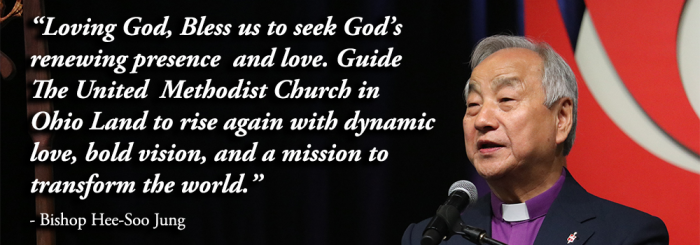
“Loving God, Bless us to seek God's renewing presence and love. Guide The United Methodist Church in Ohio land to rise again with dynamic love, bold vision, and a mission to transform the world.”
HEARING THE CALL TO MINISTRY
In The United Methodist Church we believe that all are called to ministry- meaning lay persons and clergy serve together side-by-side “to make disciples of Jesus Christ for the transformation of the world." We also believe that people are called in a variety of ways, for a variety of ministries.
On this page, you will find the stories of West Ohio Leaders and their unique calls and journeys to a life of ministry and service. We hope these stories encourage all to listen, pray, and respond to God's calling on their lives.
CLERGY

BISHOP HEE SOO JUNG, ELDER

REV. ANGIE COX, ELDER

REV. LEO CUNNINGHAM, ELDER
REV. KAREN MUNTZING, ELDER
Self-described as a non-church person, Rev. Karen Muntzing was not raised in the church. “We attended vacation Bible school at a Baptist church and had Bible storybooks around the house but nothing consistent,” she said.
As a young adult, she stayed away from the church. But throughout her life Muntzing felt God was always around trying to get her attention. She began a successful career in Columbus and quickly became obsessed with work.
“Work was my god,” Muntzing said. After committing to this job for many years, the company was sold and Muntzing was let go. Suddenly, she was lost.
Muntzing decided to try church. After many disappointing experiences, she discovered Jerome United Methodist Church and heard the preaching of Rev. Mebane McMahon. McMahon was the first person to see something of a call in Muntzing. While attending Jerome, Muntzing would email McMahon questions about the sermons; she was curious. As communication between Rev. McMahon and Muntzing continued, the pastor suggested Muntzing enroll in a theology class at the Methodist Theological School of Ohio.
On her first visit to the campus of the Ohio Seminary, Muntzing said, “My feet were not on the ground. I met Bishop Craig that day.” Muntzing enrolled in classes but was still investigating, torn between remaining a layperson or becoming ordained. After some coaxing from a leader in the church, Muntzing took the path to ordained ministry eventually as an elder.
Today, Muntzing lives out her call serving the congregation of King Avenue United Methodist Church. “I feel so privileged to be there. They are a powerful people with a powerful story. They were reconciling [congregation] before reconciling was a thing,” she said.
Mutzing offers to have a conversation with someone working to understand their call. “Let’s go have coffee and talk. Ministry is changing and expanding. It’s not something to be afraid of. It’s something that’s really good.”


REV. MARCELLA CICCOTELLI, ELDER

DR. VALERIE BRIDGEMAN, ELDER

REV. KATYA BRODBECK, ELDER

REV. ROCKY RIDDLE, ELDER

REV. SHAWN MORRIS, ELDER
As a paramedic, Shawn Morris spent the first half of his career caring for the physical and emotional needs of his patients. Little did he know that a trip to Lakeside, Ohio would bring him into a life of caring for the emotional and spiritual needs of others.
Shawn’s wife, Lea Ann, was an at-large member of annual conference. Shawn joined her. He cannot remember the specific worship service he attended; he does remember feeling a stirring in his soul.
He took a walk by the lake, sat down on a bench and heard someone say, “You can do that.” “I turned to see who was speaking and no one was there,” Morris said. He shrugged it off, tuned back toward the lake. A few moments later, he heard the voice again, “You can do this.” Shawn thought to himself, “Do what?” He heard the voice again, “Preach!” He dismissed the thought.
Eventually, he spoke to his wife and then his pastor, Rev. Diann O’Bryant. She encouraged him to attend a lay ministry academy. It was there that he felt more confirmation.
After attending United Theological Seminary, he was ordained as an elder and served in local church ministry. Through a clinical pastoral education program, Shawn found his niche: chaplaincy. For seven years, he served as a chaplain in the neonatal and pediatric intensive care departments of Nationwide Children’s Hospital. Just recently, he accepted a position as Family Services Coordinator through Lifeline Ohio, an organization that promotes and coordinates organ donation.
“There is something special about being with a family while they find hope in the tragic situation,” he said. For those who may be considering ministry he suggests seeking counsel from pastors and others. “Be willing to step out in faith,” Shawn concluded.
REV. JESSICA STONECYPHER, DEACON
Jessica Stonecypher likes spiders, horses, and people. What does that have to do with ministry? In her ministry setting, it means everything.
As a teen, Jessica exhibited talents and gifts that would make her a great pastor. People at Grace Church in zanesville were quick to acknowledge those gifts and spoke to Jessica about what they saw in her.
In undergraduate school, Jessica knew she was called to ministry but didn’t know how it would work especially since she didn’t see herself as a traditional pastor. “My call to ministry isn’t easily connected to an established career path in the church,” Jessica said. For her, the Deacon track was a perfect fit.
Currently Jessica is serving as an agriculture teacher at Zanesville middle and high schools and she teaches therapeutic horseback riding part time. Agricultural ministry has required creativity and risk.
“When we have the courage to expand our definition of ministry, we are able to notice Christ’s presence in unexpected ways. For me working alongside horses, volunteers, people with disabilities and mental health challenges have brought me the most fulfillment. God shows up in every lesson and I learn something new about who God is every time,” she said.
Jessica’s advice for those seeking clarity around their place in God’s Kin-dom is twofold. “First, allow your daily life to become ministry; remember that it all matters,” she said. “Second, dare to lean into your uniqueness. God will use your specific interests and talents for good.”


REV. HANNAH VANMETER, DEACON
REV. FRANCIS NEWMAN, LOCAL PASTOR
There is a perception that one’s life begins to wind down around age 65. This is not the case for frances Newman. Pastor Fran, as she is affectionately known at Bear Creek and Alam UMCs in Scioto River District, started seminary in her 60’s and recently completed her PhD in Biblical studies.
Fran had a successful career in accounting, sold Mary Kay Cosmetics and, at one time, managed a huge apartment complex. A highly active member of a Nazarene Church, Fran felt a nudge, a push to get more involved. A young pastor took note of Fran’s zest for learning, her grasp of the Scriptures and her passion for the church.
“At first, he was rather subtle and would provide opportunities for me to lead or speak at the church,” Fran said. She did not see herself as a preacher so anytime the pastor would as her to preach, she would say, “I’m not a preacher, but I do like to speak about God.” The pastor encouraged Fran to take a course of study course. She was hooked. “It was then that I knew God was calling me to become a pastor,” she said.
She was ordained in another denomination but was asked to be a supply pastor in The United Methodist Church. Although she was to serve as an interim pastor, she felt very strongly about the church and its congregation and eventually decided to stay with The United Methodist Church. She attended WestOhio’s Licensing school and became a licensed local church pastor.
Today, she lives out her call through preaching, praying and healing ministries. She encourages others to trust the nudge of the Holy Spirit.
“Sometimes when we follow our own path rather than what God wants us to do, things don’t work out. Instead of thinking you aren’t good enough or a job isn’t challenging enough, maybe it’s just God nudging you in a different direction,” Fran said

LAITY

ANDY HILL, ONLINE MINISTER
JODY STEVENS, DEACONESS / OUTREACH COORDINATOR
When Jody Stevens was a little girl, she loved spending time with her grandmother. Together they would do various community mission projects including visiting people in nursing homes.
“Grandma used to say that mission work starts at home. She would always speak to people no matter their age or circumstance,” Jody said. As Jody became an adult, her grandmother continued to remind her of the importance of doing God’s work.
Several years ago, Jody attended Mission U, a United Methodist Women (now known as United Women in Faith) educational program that includes Bible-based curricula and events. Carlene triplett, a deaconess spoke at the event. After a conversation with Carlene, Jody decided to apply for the deaconess program.
Just like her grandmother, Jody has never met a stranger. Within moments, Jody engages people in conversation as first time visitors at church or standing in line at the grocery store. She excels at engaging others in ministry. Jody volunteers at the Interim Hospice and Palliative Care and often recruits others to provide spiritual care through reading Scriptures and praying with those in the final stages of earthly life.
Jody is grateful for the strong women in her life who taught her the importance of sharing the Gospel and helping people recognize their value.
For those who may be struggling with their own call to ministry, Jody suggests finding your passion. “Do that,” she said. “And believe people around you when they say they see something special in You. Most importantly, pray for guidance. God will lead you in the right direction.


JAMI NATHAN, JUSTICE MINISTRIES COORDINATOR
Jami Nathan has a key role in restoring hope and healing to those impacted by the criminal justice system. As Ministries Coordinator of All In Community, a ministry started in West Ohio, Nathan finds purpose today. Her path to this point wasn’t straightforward.
For years Nathan worked and volunteered in diverse positions but never found fulfillment. Later she decided to return to school earning her bachelor’s degree and accepted a teaching position in the Corrections Center in Northwest Ohio.
Working at the center, Nathan didn’t know what to expect. She had many experiences and often shared them with her husband, Rev. Jim Nathan. One day, he smiled during one of her stories and said, “You’ve found your purpose.”
“One of the great rewards of teaching the incarcerated is seeing them accomplish what they didn’t believe they could,” Nathan said. Nathan recalls a moment when a student, a larger-than-life, ex-gang member passed his General Educational Development (GED) test. For over a year, the man struggled with the math section.
Learning he passed, Nathan wanted to deliver the news in person, but the student refused to see her. After the corrections officer demanded he see her, Nathan delivered the news in front of the student’s entire unit. congratulations!,” Nathan exclaimed. In a place where inmates and staff are not allowed to touch, only saying, “thank you.” The overjoyed student hugged Nathan, picked her up and twirled her around. This was confirmation to Nathan that she was walking in her purpose; “To break down barriers to show others their worth in this world and the next.”
When considering those who are wrestling with their call, Nathan suggests, “Being open to receiving all messages can illuminate your path forward towards a whole new world with unexpected blessings you’ll receive in return.”

CATHERINE CROWELL, LOCAL CHURCH BUSINESS DIR. AND EXECUTIVE ASST.

KENYETTA HARDY, LOCAL CHURCH DIRECTOR OF CONGREGATIONAL CARE
Kenyetta Hardy knew she was destined to do something special. She embodied leadership skills but was more comfortable in the background.
Her grandmother has always been her encourager. “She would say, ‘God doesn’t call the equipped but equips the called.” Hardy said.
When Hardy moved to Central Ohio to connect with family, she worked as a temporary employee at the West Ohio Conference Center. During this time, she began pursuing a degree in the mental health field but that didn’t work out as planned. “I said Lord if you want me have this degree, you are going to have to pay for it.”
Later, Hardy accepted a position at Scioto Ridge United Methodist Church as Director of Congregational Care, a role she leaned into confidently. Additionally, she is leading, “Renew, Refresh and Restore,” a new respite ministry at the church.
Rev. Jason Wellman, lead pastor of Scioto Ridge encouraged Hardy to work become a Certified Lay Minister; she completed her first class in February.
For anyone discerning their call, Hardy recommends praying for guidance. “Allow Him to lead.” Hardy said “I went from being a temp at the conference office with an unfinished bachelors’ degree to becoming a director for one of the best churches in denomination and conference! I love what I do!”
JULIE CARTER, DIRECTOR OF FAITH FORMATION AND LAY SERVANT MINISTRIES
Growing up in rural Ohio, Carter credits both grandmothers for influencing her life. Both invested time in molding her into the woman of faith she is today. One grandmother, a preschool Sunday school teacher, taught her the love of singing praises to God at an early age. The other encouraged Carter to engage in church programs and activities. “Also, she showed me what it means to invest in neighbors and to recognize the giftedness in each of them,” she said.
As a 7th grader, Carter recognized her call while participating in youth ministry; later becoming the group leader. She also taught vacation Bible school to smaller children. This opportunity gave Carter time to share how God loves each of them. As a teacher, the adults partnered with Carter. She said, “They invested in me, I invested in other people,” she said.
As an adult, Carter wasn’t quite fulfilled in her first job as an elementary school teacher for a Catholic church. “As I grew in relationship with God, things needed to shift because I was responding to what he was doing within me, “Carter said.
Later she applied for a position at her church, Sylvania First UMC. As she began working in this part-time position, the church leadership began to create roles using her gifts.
As she considers those curious about identifying their call, she suggests completing a Spiritual Gifts Inventory questionnaire from Discipleship Ministries and praying to God to help understand the gifts.
She also recommends the Laity Discernment Retreat led by Kim LaRue, a time to study with others and discern your call. She says, “Every single one of us has a call. God did not just give us gifts to let them sit on a shelf somewhere. He poured into every single one of us, our individuality."
To take the Spiritual Gifts Inventory, click here.
For information on the Laity Discernment Retreat, click here.

The second day of General Conference shifted from the celebratory opening worship to getting down to the business of the church, as delegates began working in their legislative committees and electing their chairs.
Leaders presented a sober picture of United Methodist finances, including the need to reduce bishops. At the same time, delegates heard hope for the denomination to pivot from church exits to revitalization.
Against a backdrop of past conflicts and division, both the Episcopal and Young People’s addresses offered hope for the denomination that will go forward from this gathering.
Bishop Holston: Become ‘who God needs us to be’
Bishop L. Jonathan Holston gives the Episcopal Address during the United Methodist General Conference April 24 in Charlotte, N.C. Holston, who leads the South Carolina Conference, encouraged delegates to tune out the noise and focus on God’s work. Photo by Mike DuBose, UM News.
Bringing a word on staying who “God needs us to be” in spite of the ever-changing noise of this world, Bishop L. Jonathan Holston of the South Carolina Conference delivered the Council of Bishops’ Episcopal Address to kick off Day 2 of The United Methodist Church’s 2020 General Conference.
“When things are happening all around us, God uses the church to make a difference,” Holston proclaimed before the crowd of delegates, observers and volunteers gathered at the Charlotte Convention Center April 24. “The church was never built for our pleasure. The church is built for God’s purpose.”
He encouraged those gathered to love the Lord and their neighbor, to embrace disciple-making, peace-making and anti-racism, and to build up and not tear down.
Striving to be “who God needs us to be” should be the only priority, he said.
Holston was selected by the Council of Bishops to deliver the address on their behalf. The council comprises 59 bishops presiding over conferences and episcopal areas across the globe, as well as retired bishops.
Young people share fears, hopes for future church
Alejandra Salemi of the Florida Conference and Senesie T.A. Rogers of the Sierra Leone Conference delivered the Young People’s Address — one in person and one remotely.
To thunderous applause, Salemi said the General Conference is being held “in the midst of what feels like an emotional whirlpool that only something like divorce proceedings can stir up.”
“When time and money and energy go towards a divorce, it has to get subtracted from somewhere else, and I believe that our young people and local congregations are paying that price while resources go toward settling disagreements,” she said.
Salemi said what is happening in the church is a microcosm of what is happening in the rest of the world, and the most difficult thing to hear in an echo chamber is the quiet, knowing voice of the truth: God’s loving whisper that reminds us “to be still and know.”
“If you can’t have hope right now, that is OK, I will have enough hope for the both of us,” she said. “The kin’dom is out there waiting to be built.”
Rogers, who was unable to get a visa to travel to the U.S., delivered his recorded address, reminding delegates that splits were normal in the Methodist Church — all the way back to the first General Conference in 1792.
Because of that history, he said, it is pointless to worry about splits and their effects when we already know that splits and Methodism are intertwined.
“Do you know that there is something else that is part of our tradition? Indeed. Reconciliation and coming together is part of our tradition. We must be more about uniting than dividing at this point,” Rogers said.
Salemi and Rogers were selected by the Division on Ministries with Young People at Discipleship Ministries, which organizes the Young People’s Address as an opportunity for young United Methodists to witness about the church’s impact on their own lives and the lives of others.
Delegates urged to ‘restart church’ with less
At the first gathering of the policymaking body since a quarter of the denomination’s U.S. churches left, the delegates heard sobering news about the financial state of The United Methodist Church.
Before the delegates is a proposed denomination-wide budget that would be The United Methodist Church’s lowest in 40 years. It also represents the biggest budget drop in the denomination’s history.
“This is a General Conference that must send clear signals to the local church,” said incoming Council of Bishops President Tracy Malone, “that we are keenly aware that the loss of membership and the decline of sustainability has a direct influence on the amount of funds available to support ministry.”
The proposed 2025-2028 denominational budget coming before delegates is $353.1 million — a 42% reduction from the budget delegates approved at the 2016 General Conference, the assembly’s last regular session. Under that budget proposal, about $347 million would come from the U.S. and $6.1 million from the central conferences — church regions in Africa, Europe and the Philippines.
The Rev. Moses Kumar, the top executive of the General Council on Finance and Administration, emphasized that the budget includes cutting the number of bishops in the U.S. and adding only two bishops in Africa, rather than the initially planned five. The budget would reduce the number of bishops from a total of 66 funded in 2016 to a total of 54.
“I want to emphasize, GCFA has no authority to control the number of bishops elected,” he said. “It is our role to communicate what we can and cannot afford.”
A vision of the future
“The Pathway for our Next Expression,” a presentation by members of the Connectional Table and Council of Bishops, urged delegates to envision what The United Methodist Church will become. Acknowledging the need to refashion the church going forward and adapt to reductions in resources, the presenters encouraged a renewed commitment to discerning how to carry out the mission and ministry of the church.
Judi Kenaston, chief connectional ministries officer of the Connectional Table, said there has probably not been a General Conference that is more highly anticipated than this one.
“The quadrennium that never wants to end has been long and filled with events that influence and shape everything that we will do this week,” she said. “The United Methodist Church that many of us have known for a lifetime suddenly looks far different than we have ever seen.”
Bishop Thomas J. Bickerton, outgoing president of the Council of Bishops, called for a pivot away from disaffiliation and toward mission and ministry.
“This is a General Conference that is being called to act strategically in the short-term so that we can act relevantly in the long-term,” he said.
Revised Social Principles, General Book of Discipline
Delegates heard proposals that would alter two of the denomination’s bedrock documents.
The Standing Committee on Central Conference Matters gave an update on work toward a General Book of Discipline. That work entails the standing committee — a permanent committee on General Conference — proposing what parts of the Book of Discipline’s Part VI apply to all regions and what they can adapt. Part VI, the Discipline’s largest section, deals with organization and administration.
The goal is to have a shorter, more globally relevant Book of Discipline. Whatever the new General Book of Discipline no longer includes will be subject to adaptation at the regional level.
John Hill, interim top executive of the United Methodist Board of Church and Society, presented a report on the proposed revised Social Principles, which he called “a love letter to our church … to inspire us to be the beautiful beloved community of God.” During a short presentation, he asked delegates to “prayerfully consider” the changes, a goodly amount of which involve the ongoing conversation around the role of LGBTQ people in the church.
General Conference photos
UM News has photographers on the plenary floor of General Conference 2024 and at special events and meetings throughout the session. View photos from each day on Flickr.See photos
In other news
- A yoga symbol featured on the General Conference platform was removed after an Asian American caucus stated that it was offensive. The New Federation of Asian American United Methodists penned an open letter to Bishop Thomas Bickerton, outgoing president of the Council of Bishops, expressing frustration at the inclusion of the symbol, which is also utilized by the Hindu Nationalist government to persecute religious minorities in India. The group asked for a “deep understanding of the rise of forces that are offensive to fellow Christians in other parts of the world.”
- A group of United Methodist clergy and laity in Congo organized themselves to track the progress of General Conference online. Jimmy Kasongo, the Kivu Conference youth president, said he has seen all the proceedings on his phone. “Today, even though I haven’t left, I am aware of everything that is happening, which is something new compared to the General Conferences of previous years,” he said. Mwaidi Jolie, secretary of United Methodist Women in the South Kivu Conference, thanked the church for the innovations in communication. “Today is my first time to see the bishops’ procession live,” she said, “and I was greatly edified by the sermon of Bishop Thomas J. Bickerton during the opening worship.”
Used from United Methodist News

In early 2025, Bishop Hee-Soo Jung announced the creation of the Ohio Episcopal Area Task Team which has eight members and two ex-officio staff members from each of the East Ohio and West Ohio Conferences. The role of the Task team is to listen, discuss, and discern about forming a new, unified Ohio Conference of The United Methodist Church. Rev. Doug Anderson, who is serving as the team's consultant, is well known in both East and West Ohio. Over the years, he has led multiple workshops and seminars in both conferences.
“God is calling us into this new strategic journey together. This task team has been prayerfully selected—each person strong in faith and deeply committed to The United Methodist Church. They are organized for this important work,” Bishop Jung said.
The decision to create a new Annual Conference is not made by the task team, the cabinets, or the bishop. That decision will be made by the Annual Conferences themselves in 2027
To learn more about the Task Team Members and their work, click here. Please watch the video below to review .
What We're Hearing About Unification: Three-Word Reflections from Annual Conference Members
Executive Summary
On May 30, 2026, members of the West Ohio Annual Conference were invited to submit three words describing their perspectives on the possible unification of the East and West Ohio Conferences. The 255 responses were reviewed and analyzed for word frequency; positive, negative, and cautionary themes; key takeaways; overall sentiment; and communications implications.
The West Ohio 3-word responses are strongly hopeful and constructive. The most repeated ideas center on unity, strength, opportunity, efficiency, shared resources, mission, growth, collaboration, community and hope. Respondents repeatedly describe a future marked by connection, expanded ministry capacity and a stronger shared witness across Ohio.
The positive language is not only organizational; it is deeply missional and theological. Many responses connect unification to God’s work, Christ-centered mission, discipleship, outreach, grace, fellowship and reaching new people. The comments suggest that participants see the potential for stronger ministry when structure, resources and relationships are aligned around shared mission.
Cautionary words are present but less dominant. Concerns cluster around confusion, challenge, anxiety, uncertainty, large geography, travel, additional work, chaos, preserving institutional structures and the need for clarity. These responses point to practical and process-related questions that should be named honestly alongside the positive themes.
Bottom line
The West Ohio responses lean hopeful and mission-focused, with repeated emphasis on unity, strength, opportunity and shared resources.
Click here to review the West Ohio Annual Conference summary.
Click here to review the East Ohio Annual Conference summary.
Next Steps
September 12, 2026
- Work group reports will be presented to Task Team members.
September – October 2026
- Work group reports will be presented to Conference governing bodies.
November 2026
- The Task Team will present its report to Bishop Hee-Soo Jung.
December 2026
- The Task Team’s report will be made available to Ohio clergy and laity.
June 2027
- West Ohio and East Ohio Annual Conferences will vote on becoming one Conference.
- Both East Ohio and West Ohio Annual Conferences must approve the proposal by 67% or more, without rounding up, for the new Conference to be formed.
June 24, 2027
- A special online session of North Central Jurisdictional Conference would be held to approve and recognize the new Ohio Conference.
August 27, 2027
- A Joint Unifying Conference would be held to vote on budget and other matters necessary to form the new Ohio Conference.
January 1, 2028
- The new Ohio Conference would become effective.
For more information, click here to read the Ohio Episcopal Area Task Team pamphlet:
“Let us offer our prayers that the Spirit will lead this team to cast a vision for a strong, new United Methodist Church in Ohio,” Bishop Jung said.
As the Ohio Episcopal Area Task Team begins its work, Bishop Jung has written this prayer for use by individuals and congregations:
Ohio Episcopal Area Task Team References and Resources: