Framework for Leadership
For Congregational Leaders in the West Ohio Conference of the United
Methodist Church
Strong, effective leadership is essential for guiding congregations through times of change,
fostering resilience, and inspiring hope. As leaders guide their congregations, they have a
unique opportunity to strengthen their mission and cultivate vibrant, faithful communities that
can confidently navigate disruption and uncertainty. Identifying and developing key leadership
competencies is crucial to equipping leaders for this task.
These competencies are organized in three aspects of leadership:
These competencies are organized in three aspects of leadership:
- Lead Self: Cultivating a strong personal foundation through deepened discipleship,
which is foundational for effective leadership. - Lead Others: Developing the ability to build teams, navigate challenges, and drive
meaningful change. - Lead Communities: Guiding the congregation with clarity and vision to maximize
collective impact in fulfilling its mission.
Each stage consists of three core competencies:
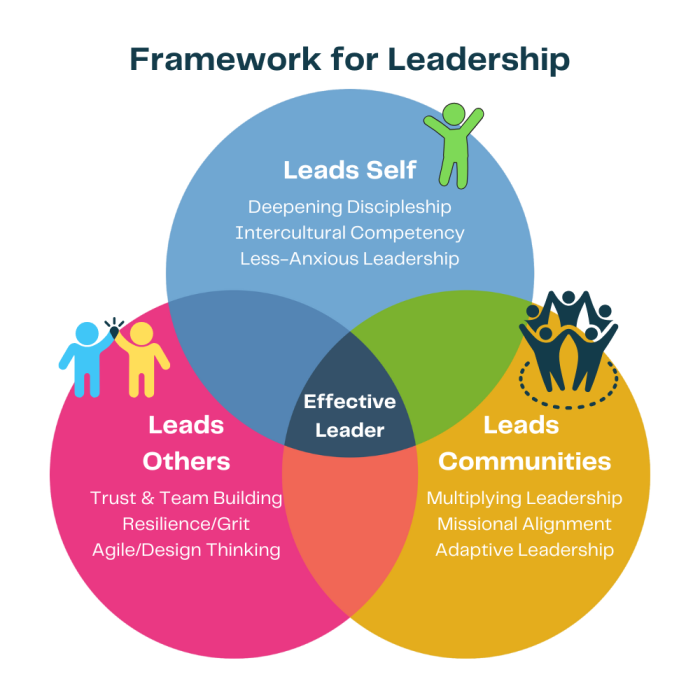
All of these competencies work together to cultivate adaptive, Christian leadership—the ability
to embrace uncertainty, foster innovation, and encourage experimentation. In an ever-changing
landscape, adaptive leaders help their congregations discover new possibilities, knowing that
solutions often emerge through faithful exploration.
Our focus is on equipping leaders with the most impactful skills—alongside necessary technical
expertise—to strengthen both their leadership and their congregations. The following pages
provide a deeper exploration of each competency and how it contributes to a thriving future.
LEADS SELF
At this phase, the focus is on deepening discipleship, as these competencies serve as the
foundation for all aspects of leadership. The core competencies for leading self include Thriving
Spiritually, Intercultural Competency and Less-Anxious Leadership, each of which is described
below.
The core practices include:
● Self-Awareness
● Boundary Setting
● Habit Formation
● Deepening Discipleship through Spiritual Disciplines
● Continuous personal (spiritual, physical, emotional) and professional development
● Using the IDI (Intercultural Development Inventory) to grow in cultural humility
Thriving Spirituality (Deepening Discipleship)
Leaders with a thriving spiritual life are better equipped to respond to leadership challenges
because they know that only the grace of God can equip them and sustain them. They
understand that self-care is a part of their spiritual life and is not optional. Their spiritual
authenticity is attractive to others and multiplies their impact.
Intercultural Competency
The corporate world has recognized that intercultural competence positively affects the bottom
line. The church needs to understand that leaders with intercultural competence build
communities of trust and belonging. This helps congregations better understand and engage
with our rapidly changing world, as well as helps to establish collaborative relationships that
increase community impact.
Less-Anxious Leadership
Less-anxious leadership, from a family system’s perspective, means leading in a way that stays
calm and steady, even when things get stressful or chaotic. A less-anxious leader is like the
anchor in a storm—they don’t get swept up in the waves of emotions around them.
This kind of leadership is based on understanding how people are connected and influence
each other, just like in a family. Instead of reacting emotionally when things get tough, a less
anxious leader stays grounded, makes thoughtful decisions, and helps others stay calm too.
LEADS OTHERS
While continuing to strengthen their ability to lead themselves, this phase emphasizes building
teams, navigating challenges, and driving change. The core competencies for leading others
include Trust and Team Building, Positive Intelligence (Resilience/Grit), and Agile/Design
Thinking, each of which is described below.
The core practices include:
● Leadership through self-differentiation
● Relationship building
● Gathering and organizing people
● Building resilience
● Bold experimentation (risk-fail-learn)
● Curiosity, empathy and humility
● Seeking feedback to improve leadership
Trust and Team Building
According to Patrick Lencioni, trust is the foundation of effective teams. In addition, effective
teams engage in healthy conflict, are committed to team goals, are accountable to one another
and are results-oriented. Competent leaders not only foster trust, but they also understand
these characteristics and know how to create the circumstances that make them possible.
Developing Resilience and Grit
Resilience is the ability to withstand or recover quickly from difficulties. While family systems
theory and emotional intelligence help leaders maintain a less-anxious presence, the capacity to
self-regulate automatic reactions is crucial for leading effectively, even in high-pressure
situations. This self-regulation fosters resilience and grit, enabling leaders to persist through
even the most overwhelming challenges.
Agile and Design Thinking
Design thinking (risk-fail-learn) as well as agile thinking change the way leaders approach the
challenges their congregations face. They facilitate moving quickly, testing and learning in ways
that minimize risk and maximize trying different approaches. This also reduces the perceived
risks because small experiments are not as threatening to those who resist change.
LEADS COMMUNITIES
While continuing to grow capacity for leading themselves and others, at this stage the focus is
on the leader’s ability to mobilize and inspire discipling leaders so that more transformed lives
transform lives. The core competencies for leading organizations or movements are described
below and are Vision Casting (Multiplying Leadership), Missional Alignment, and Adaptive
Leadership.
The core practices are consistently:
● Communicating clearly and succinctly
● Maintaining strategic focus
● Strengthening systems and processes
● Ensuring sustainability
● Engaging he
Vision Casting (Multiplying Leadership)
The importance of vision is not that it is correct but that it gets everybody moving toward a
preferred future. Leaders need to cast vision because without clarity and focus, congregations
get anxious. When vision, agile/design thinking and adaptive leadership are combined,
congregations are more likely to move forward, even when they don’t know where it will lead.
Missional Alignment
A mission-focused leader sees everything through the lens of missional alignment. They
evaluate everything in terms of whether it furthers the mission or not. Likewise, they maximize
team effort by ensuring it is aligned with the mission. This often means saying “No” to activities
that seem positive but actually distract from achieving the congregation’s mission.
Adaptive Leadership
Adaptive leaders not only understand the difference between a technical problem and an
adaptive one, but they are also able to methodize the resources to address the latter. They are
able to build trust and increase collaboration so that everyone’s voice is heard. This increases
the impact of testing new ideas and learning new approaches.