Finding the Presence of God Beyond the Walls of Palestine
Editor’s Note: This article was written by Bishop Hee-Soo Jung in the hills of Palestine in November 2026 during an Ohio Episcopal Area 10-day fact-finding and peace studies program in Israel and Palestine led by The Society for Biblical Studies: Learning, Service, Renewal.
There is something profoundly sacred about receiving hope from people whose daily lives are surrounded by suffering.
Hope spoken from a place of comfort is one thing. Hope proclaimed by those who live under occupation, endure humiliation and struggle to preserve their dignity is something altogether different. Their words carry the weight of suffering, the courage of resistance, and the quiet mystery of faith.
Here in Palestine, I have encountered people whose circumstances seem to offer little reason for optimism. Their freedom of movement is restricted. Their communities are divided by barriers and checkpoints. Their future remains uncertain, and their appeals for justice are too often neglected by the powerful institutions of the world. Yet they continue to speak of hope.
Their voices are sometimes gentle, almost whispered. But within my soul, they resound like thunder. I find their testimonies more compelling than many elaborate interpretations of the Book of Revelation. They do not merely predict a distant future when justice will finally prevail. They reveal something of God's presence in the very midst of human suffering.
Perhaps revelation is not only the unveiling of what is yet to come. Perhaps it is also the awakening of our eyes to recognize the sacred courage already present among those who refuse to surrender their humanity.
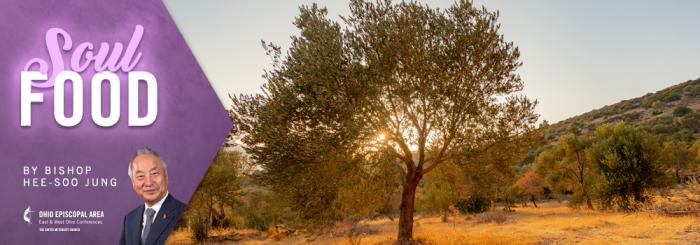
As I travel through the hills of Israel and Palestine, the landscape itself seems to carry the wounds of history. The rocky hills, ancient terraces, and winding roads are breathtakingly beautiful. Olive trees, some centuries old, stand rooted in the earth as witnesses to generations of prayer, labor, sorrow and longing.
Yet these same landscapes are interrupted by separation barriers, restricted roads, settlements and military checkpoints. Ordinary journeys become complicated negotiations with authority. What should be a simple passage from one village to another becomes an experience of uncertainty and vulnerability.
I find myself asking, “How can such conditions be accepted as normal”?
The sight of armed soldiers and repeated checkpoints awakens memories from my youth in South Korea. I remember the streets of Seoul during the late 1970s and early 1980s, when military dictatorship and martial law shaped the atmosphere of everyday life. Soldiers, surveillance, intimidation and the constant awareness of political power created an invisible architecture of fear. Those memories have never entirely left me.
Yet what I encounter here brings those memories back with a force I did not anticipate. The historical circumstances are different, but the humiliation imposed by unchecked power feels painfully familiar. Whenever human freedom is denied, something sacred is wounded.
Some Palestinians have chosen to leave their ancestral homeland, seeking safety and the possibility of a different future. Others remain, despite immense difficulties, determined to preserve their homes, communities and memories. I cannot judge those who leave. Neither can I romanticize the suffering of those who stay.
But I am deeply moved by the courage of people who continue to cultivate their fields, educate their children, worship together, care for their neighbors and plant olive trees for generations they may never see. Their daily faithfulness becomes a form of resistance.
And perhaps this is where hope begins – not in the certainty of victory, but in the refusal to allow injustice to have the final word.
The great Palestinian poet Mahmoud Darwish wrote: "We have on this earth what makes life worth living." What a remarkable confession.
Darwish, who knew exile, displacement and the ache of belonging, did not reduce the meaning of life to political struggle alone. His poetry remembers the fragrance of bread, the tenderness of love, the beauty of ordinary existence and the enduring intimacy between human beings and the land they call home. His poetry reminds me that a people struggling for freedom are not merely symbols of a political cause. They are human beings who wish to love, laugh, raise children, grow old, remember their ancestors and live without fear.
Their longing is not extraordinary. It is profoundly ordinary. And that is precisely why it is sacred.
A homeland is more than a geographical territory. It is the place where memory becomes belonging, where generations share their stories and where the living remain in conversation with those who have gone before them.
The biblical landscapes of this region preserve the memories of countless encounters among peoples, cultures and traditions. Jewish and Palestinian histories are marked by profound suffering and conflict, but also by memories of coexistence, neighborliness and shared humanity.
I cannot believe that honoring Jewish suffering requires indifference to Palestinian suffering. Nor can the dignity and freedom of Palestinians be secured by denying the humanity or legitimate security of Jewish people.
The God of Abraham cannot be reduced to the possession of one people against another. The prophetic tradition calls us toward something greater: a justice that protects the vulnerable, a hospitality that welcomes the stranger and a peace that does not require the humiliation of one's neighbor.
The prophet Amos declares: "Let justice roll down like waters, and righteousness like an ever-flowing stream." – Amos 5:24 (NRSV)
Such justice cannot remain an abstraction. It must enter the roads people travel, the homes where families sleep, the schools where children learn and the ordinary places where human dignity is either respected or denied.
As a Christian bishop, I cannot speak of God's peace while remaining indifferent to structures that deny people their freedom and dignity. Yet I also recognize how difficult it is to speak of God in the face of prolonged suffering.
I find myself praying: “God, how are You working within this wounded history? Where is Your justice when the walls remain standing? Where is Your peace when the roads are blocked and the future remains uncertain?”
These are not questions that can be answered with easy religious assurances.
The God revealed in the crucified Christ does not invite us to escape the suffering of the world through spiritual explanations. Rather, God enters the vulnerability of human existence.
The cross is not a divine justification for suffering. It is God's profound solidarity with those who suffer at the hands of injustice. And resurrection is not the denial of wounds. It is the proclamation that wounds, violence, and death do not possess ultimate authority over life. This conviction changes how I understand hope.
Hope is not an optimistic prediction that everything will eventually turn out well.
Hope is the spiritual courage to participate in God's work of justice and reconciliation even when the outcome remains uncertain.
Noam Chomsky, whose lifelong criticism of political power has challenged the moral complacency of our world, once reflected on the danger of surrendering to despair. He said, "If we succumb to despair, we will help ensure that the worst will happen."
His words remind me that hope carries responsibility. Despair can become another form of surrender to the very powers we oppose. Hope, by contrast, invites us to act, to organize, to accompany, to speak and to refuse the normalization of injustice.
Chomsky's political insight and Darwish's poetic imagination meet at an important place. Both remind us, in different ways, that humanity must never relinquish its capacity to imagine and create a more just world.
But Christian hope carries this conviction into an even deeper spiritual horizon. Our hope is grounded not merely in human possibility but in the faithfulness of God, who continually calls life out of death, freedom out of bondage and reconciliation out of estrangement.
Still, such hope must never become an excuse for passivity.
The resurrection of Christ calls us to become participants in the healing of the world. As I listen to Palestinian Christians and their neighbors, I discover that their witness does not simply ask me to feel compassion for their suffering. It asks me to examine my own faithfulness.
What does it mean to preach peace while others must pass through checkpoints? What does it mean to celebrate freedom while others must negotiate permission to travel between their own communities? What does it mean to believe in the universal love of God while accepting political arrangements that diminish the dignity of some of God's children?
These questions do not permit me the luxury of remaining a distant observer. They invite me into solidarity.
I am also reminded that resistance need not surrender itself to hatred. Indeed, one of the most profound spiritual challenges is to resist injustice without allowing injustice to determine the character of our souls. To confront oppression while refusing to dehumanize another people. To remember suffering without making revenge the inheritance of the next generation. To seek justice without abandoning the possibility of future friendship.
This is neither sentimental reconciliation nor passive acceptance. Genuine reconciliation requires truth, accountability, freedom and the restoration of dignity.
Love without justice becomes an empty consolation. Justice without the horizon of love can lose sight of the humanity it seeks to defend. The gospel calls us to hold both together.
I return in my imagination to an ancient olive tree I encountered in Taybeh. Its roots have embraced this wounded earth for more than a thousand years. Empires have risen and fallen. Generations have worshiped, struggled, loved and died. Yet the tree continues to receive sunlight and offer its fruit.
The olive tree does not ask the identity of those who rest beneath its branches. It simply continues to bear witness to life. Perhaps there is a theology of hope hidden within its roots.
Hope does not begin only when the wall comes down. Hope is already growing wherever people refuse to let the wall define the limits of their humanity. It grows when neighbors share bread. It grows when parents teach their children to remember without hatred. It grows when a congregation gathers for prayer despite uncertainty. It grows when a wounded community continues to dream of freedom, dignity, and peace for all. And it grows when strangers become companions in the long struggle for justice.
During this pilgrimage, I have come to recognize a new desire within my own vocation. I want to become a priest of hope.
Not a priest who offers easy explanations for suffering. Not a religious leader who speaks comfortably about peace while remaining distant from the cries of the oppressed. Not one who claims to possess hope as though it were a private spiritual achievement.
I want to become a priest who listens. A priest who remembers the names and stories of those whose dignity has been denied. A priest who recognizes the presence of God in the courage of ordinary people. A priest who refuses to separate prayer from justice, compassion from responsibility or love from the struggle for human freedom.
Above all, I want to learn hope from those who have every reason to despair and yet continue to live with courage. Perhaps they are the true teachers of hope.
They do not necessarily speak in the language of systematic theology. They speak through the daily practices of survival, tenderness, memory and resistance.
Their lives become living commentaries on the gospel. And their witness calls me back to the words of Jesus: "Blessed are the peacemakers, for they will be called children of God." – Matthew 5:9 (NRSV)
Peacemaking is not the maintenance of an unjust silence. It is the courageous work of transforming the conditions that prevent people from living together in dignity. It is the practice of seeing the face of God in those whom political systems would teach us to fear, dismiss or forget.
As evening descends upon these hills, I imagine the prayers rising from churches, mosques and synagogues across this ancient land. Different languages. Different memories. Different understandings of the sacred. Yet beneath these differences remains a shared human longing: to live without fear, to love without restriction and to know that one's children have a future.
I pray that these prayers may someday become more than parallel voices rising toward heaven. May they become a common commitment to the dignity of every human life. May the memories of suffering become sources of compassion rather than perpetual captivity. May the ancient roads once again connect neighbors rather than separate them. And may the olive trees continue to bear fruit for generations whose lives will no longer be governed by fear.
Tonight, I do not possess answers to all the questions that this pilgrimage has placed before me. But I carry something precious. I have encountered people who continue to hope. And through their courage, I have glimpsed the mysterious persistence of God's grace.
Perhaps the deepest revelation of this journey is not that God will someday bring hope to a hopeless world. Perhaps it is that God is already present wherever human beings refuse to abandon one another.
Hope is not simply the promise that suffering will end. It is the sacred refusal to let suffering become the final truth about humanity.
And I want to spend the rest of my ministry bearing witness to that hope.
A Prayer
God of Abraham, God of the prophets,
God revealed in the crucified and risen Christ,
teach us to recognize Your presence
among those who struggle for dignity and freedom.
Do not allow our faith to become an excuse
for indifference,
nor our longing for peace
to become a way of avoiding justice.
Give us the courage to confront oppression
without surrendering to hatred,
to remember suffering
without abandoning reconciliation
and to proclaim hope
without denying the wounds of history.
Bless the children of Israel and Palestine.
Protect every life threatened by violence.
Strengthen those who work for a just and lasting peace.
And make us faithful companions
of all who refuse to surrender their humanity.
Lord, make me a priest of hope –
not merely in my words,
but in the way I listen, love
and walk beside Your people.
Amen.