The Ohio Episcopal Area Task Team is exploring a potential new, unified Ohio Conference. For the past 18 months, the 19 work groups of the Task Team have been gathering information from and having discussions with staff, laity and clergy from both the East Ohio and West Ohio Conferences.
Throughout the rest of September and during October work group reports will be presented to Conference governing bodies. The Task Team will present its final report to Bishop Hee-Soo Jung in November, and it will then be shared with the laity and clergy of the Ohio Episcopal Area. West Ohio and East Ohio Annual Conferences will vote on becoming one Conference during their respective Annual Conference sessions in 2027.
“No final decision has been made; the Task Team prepares and recommends; the Church listens and discerns; and the 2027 Annual Conferences decide,” Bishop Jung said.
Click here for the Ohio Episcopal Area Task Team page to learn more.
The Ohio Episcopal Area Task Team has an update to share with the people of the East Ohio and West Ohio Conferences.
In early 2025, Bishop Hee-Soo Jung announced the creation of the Ohio Episcopal Area Task Team which has eight members and two ex-officio staff members from each of the East Ohio and West Ohio Conferences. The role of the Task team is to listen, discuss, and discern about forming a new, unified Ohio Conference of The United Methodist Church.
This Spring, the Task Team hosted seventeen listening sessions attended by 254 people representing East Ohio and West Ohio staff, and laity, and clergy of rural, urban, and suburban churches of various sizes across multiple geographic areas. The results of these listening sessions may be found here.
In Fall, 2025, Task Team members will serve as conveners of work groups consisting of Conference staff/leadership as resource members and up to 10 clergy/laity representing both East and West Ohio. Members of the 19 groups will begin by creating a picture of what a new conference would look like in their respective area and how it would contribute to our mission of making disciples of Jesus Christ for the transformation of the world. The groups are listed here.
To learn more about the members of the Task Team and their 3-year plan, visit their webpage.
The role of the Ohio Episcopal Area Task Team created by Bishop Jung in early 2025 is to “listen, discuss, and discern about forming a new, unified Ohio Conference of The United Methodist Church.” Last summer 19 work groups were formed, each resourced by Conference leadership and comprised of up to 10 clergy/laity members from across both Ohio Conferences.
The members of one of the work groups invite you to anonymously complete an online survey so that your thoughts can be heard and considered. No personal identifying data will be collected. Your feedback will help inform future Conference staffing, structure, and culture so that the new unified Conference can best support local churches in the years ahead.
Click here for survey.
Call. Grow. Support. Sustain
The heart of this ministry is caring for the people who carry the mission.
The Office of Leadership Wellness and Renewal exists for the clergy and laity who are serving our churches and communities.
Wellness is about sustaining the person. Renewal is about sustaining the call.
This office wants people to thrive not just survive and to remain connected to the call that brought them into ministry and service in the first place.
The work begins with listening to the people who are serving.
We want to understand what is helping people thrive, where support needs to be stronger and what clergy and laity are experiencing across Ohio.
Care must become action.
The office will help strengthen what works, address gaps and follow through.
The initial focus is ministry calling, whole-person wellness and long-term sustainability.
- Ministry Calling: helping laity and clergy recognize gifts, discern vocation and respond to God’s call.
- Whole-Person Wellness: supporting the spiritual, emotional, relational and vocational well-being of those who carry the mission.
- Ministry Sustainability: helping people remain supported, connected and fruitful in service to the mission.
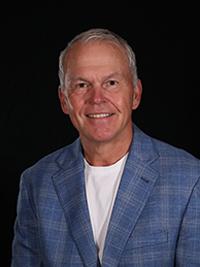
Rev. Ed Fashbaugh, Executive Director of Leadership Wellness and Renewal
(330) 499-3972 ext. 136
efashbaugh@eocumc.com
Bishop Jung has tasked the Office of Fresh Starts and New Beginnings with helping launch 100 new faith communities by 2030 to strengthen and expand the United Methodist presence across Ohio. To accomplish this vision, a structure has been established that invites laity, clergy, congregations, and district leaders to participate in discerning where God is already at work and where new opportunities for ministry may emerge. Recognizing that those closest to a community are often best positioned to understand its strengths, needs, and possibilities, District Strategy Teams (DSTs) were created to provide local insight, prayerful discernment, and strategic guidance within each district.
The purpose of the District Strategy Team (DST) is to work in collaboration with the District Superintendent and the Office of Fresh Starts and New Beginnings by prayerfully discerning God’s vision for the district, asking thoughtful and strategic questions, and identifying key areas of growth as potential locations for new faith communities, adoptions, mergers, and new models in alignment with conference processes. The team also seeks to identify existing congregations with potential for refocus and redevelopment toward greater vitality, to pray consistently for pastors, to provide systematic support that connects planters with existing congregations, and to effectively utilize the resources and systems available within East and West Ohio (Ohio Episcopal Area) to advance the Kingdom.
Each DST is comprised of clergy and laity. If you have a question or would like to talk to the DST for your district, please reach out to the chairperson listed below.
Central Valley - Diane Shoemaker
Great Miami River - Rev. Nitos Dobles
Hocking River - Rev. Lauren Fuchs
Maumee River - Rev. Megan Croy
Northern Waters - Susan Achberger
Olentangy River - Sara Meriweather
Scioto River - Suzanne Bandy
South Forest - Andrew Thompson
Western Lakes - Camille Frecking-Cover
West Plains - Jon Butler
For 2026, District Strategy Teams used a Traffic Light Assessment tool to identify areas where there may be opportunities to expand the reach of the Church and connect with people in new ways. Green light areas are places where possibilities exist for new expressions of ministry, either through an existing congregation, a partnership of churches, or a newly formed faith community. Rather than prescribing a specific approach, this designation simply begins a season of prayerful discernment and conversation with local leaders, the District Superintendent, and the Fresh Starts & New Beginnings Office about what could be possible together. You can view the 2026 map below and descriptions below it.
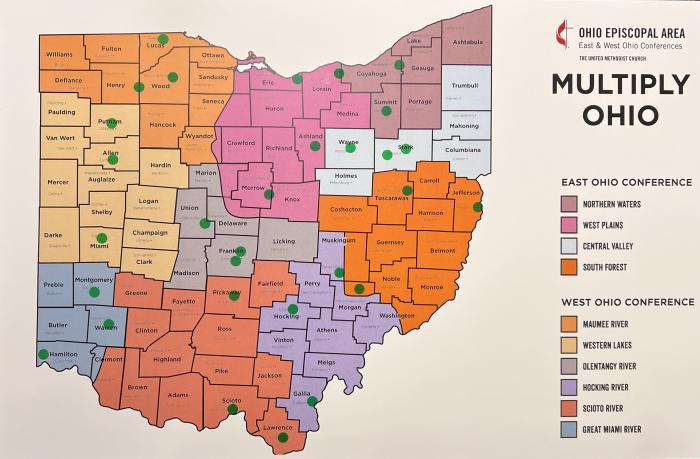
MAUMEE RIVER DST
Toledo Campus Ministries (Lucas
County)
BGSU Campus Ministries (Wood
County)
MRD Digital Church
WEST PLAINS DST
Ashland County
Vermillion Grace (Erie County)
Morrow County
NORTHERN WATERS DST
Elyria First UMC
East Cleveland
Akron First UMC
CENTRAL VALLEY DST
NW Side of Wooster (Wayne
County)
Crystal Park (Stark County)
Westbrook Park (Stark County
Perry Heights Trinity ( Stark County
WESTERN LAKES DST
Lima Area (Allen County)
Troy area (Miami County)
Putnam County
OLENTANGY RIVER DST
42 Corridor from Jerome to
Beloved to London(Union County)
Columbia Heights (Franklin
County)
Lewis Center (Franklin County)
SOUTH FOREST DST
New Philadelphia First and Dover
(Tuscarawas County)
Steubenville (Jeerson County)
Smith Chapel and Oakland
(Morgan County)
GREAT MIAMI RIVER DST
First Fil-Am Church
Little Miami – Maineville
Harrison
SCIOTO RIVER DST
South Bloomfield (Pickaway
County)
Portsmouth (Scioto County)
Ironton (Lawrence County)
HOCKING RIVER DST
Gallipolis (Gallia County)
Logan (Hocking County)
South Zanesville (Muskingum
County
All-Ohio School of Ministry 2026: Caring, Learning and Renewing in Community
“Abundant Grace, Fed by Christ, Sent to Feed the World, ‘You Feed Them’” was the theme of the 2026 All-Ohio School of Ministry held August 31 – September 2 at Kalahari Resorts & Conventions in Sandusky. The three-day event was an opportunity to worship, fellowship, learn, reflect, and spend time together in renewal.
Bishop Hee-Soo Jung called the All-Ohio School of Ministry a spiritual homecoming.
“This is a time to know one another more deeply, to learn from one another, to encourage and love one another and to listen together for the movement of the Holy Spirit,” Bishop Jung said in his opening worship service sermon.
The bishop concluded his message “Rooted in Love, Abounding in Hope” with an invitation for clergy to return to the love of Christ.
“If ministry has become mostly responsibility, return to intimacy with Jesus. If you have grown weary, let Christ hold what you can no longer carry alone. If disappointment has hardened your heart, allow the Holy Spirit to soften it again. If fear has narrowed your imagination, ask the God of hope to open your eyes to the new thing already beginning. If you have become isolated in ministry, reach out and receive again the gift of companionship. Look around this room. We are not strangers. We are companions in the gospel and members of one body,” Bishop Jung implored.
Guest Presenter Rev. Dr. Elaine A. Heath
Bishop Jung invited United Methodist elder, author, theologian, professor and former university dean the Rev. Dr. Elaine A. Heath to lead plenary sessions throughout the week. She focused on the impact trauma can have on clergy and congregations and cast a vision for fresh expressions for new faith communities that are trauma informed and trauma responsive.
“It’s important that we as clergy can be well enough and our congregations can be well enough to meet the challenges that are coming toward us at this time so we can be faithful, be present, have creative energy and be able to practice wise discernment. To do those things we must attend to the collective trauma that we are living in right now because of war, because of the economy and because of social polarization – and then within The United Methodist Church system because of disaffiliation and the stress in the system because of decline,” Heath said in recapping the topics of the week’s teaching moments, which also featured time for table conversations and somatic self-care.
Guest Preacher Bishop Frank J. Beard
For Tuesday’s morning worship service and for the closing service with communion on Wednesday, bishop Jung invited Bishop Frank J. Beard to be the guest preacher. Bishop Beard served as resident bishop of the Illinois Great Rivers Conference before going on medical leave. He and his wife Melissa are avid anglers and in September 2025 launched the evangelical Catching Like Jesus Ministries to reach people in new ways.
“People often ask me, ‘what’s the key to catching fish?’ Here are my top five keys, and when I say catching fish, I mean catching souls,” Bishop Beard shared. “Fish where the fish are at. Fish where the fish are biting. Fish with what the fish like to eat. Fish with the right equipment. Fish with a willingness to change methodology. And I’ll throw in a sixth one for free: fish like Jesus taught the original disciples.”
Bishop Beard reminded the clergy to continue following the lead of Jesus and catch fish anywhere they can.
“There is no place in the Bible where the world is commanded to go to church. The church is commanded to go the world!” Bishop Beard declared.
Guest Musician Rev. Dr. Nia Allen
The final evening of the All-Ohio School of Ministry featured a musical testimony from a leading voice in contemporary Christian and Gospel music, Nia Allen. With five consecutive Billboard top charting hits and three #1 singles, she has built a catalog that impacts audiences and resonates far beyond the stages she has shared with CeCe Winans, Mariah Carey, Fred Hammond, Tori Kelly, Phil Wickham, Beth Moore, David and Nicole Binion and many others.
Episcopal Office Reflections: Discerning One Ohio Conference
In the closing plenary session Bishop Jung shared with clergy a handout titled “One Ohio Discernment” that outlines the ongoing process of exploring forming one new Ohio Conference. Rev. Ed Peterson then offered a brief recap of the process the Ohio Episcopal Area Task Team and its 19 work groups are using in gathering information from staff, clergy, and laity of the East and West Ohio Conferences and Rev. Linda Middelberg provided the timeline of what will occur between now and the June 2027 vote on the Task Team’s recommendation by each Annual Conference.
“There’s a very significant point that I want you to hear: no final decision has been made; the Task Team prepares and recommends; the Church listens and discerns; and the 2027 Annual Conferences decide,” Bishop Jung told clergy.
The bishop then asked that each person:
- pray and seek the wisdom of the Holy Spirit rather than simply defending institutional preferences.
- learn by studying the Task Team report and the information that continues to emerge.
- listen to receive the experiences and perspectives of people whose realities differ
from their own.
- discern together by asking freely, speaking truthfully and resisting the urge to create groups of winners and losers.
For the most up-to-date information about exploring the formation of a new Ohio Conference, visit this page on the WOC website.

The United Methodist Foundation of West Ohio makes grants to advance the strategic goals of the West Ohio Conference through a competitive application process. The grant program focuses on providing financial support for established programs and program expansion of local churches, ministries and organizations across West Ohio; and for scholarships. Please contact Program Manager, Maddy DeWitt at mdewitt@wocumc.org for more information.
Grant Cycles and Categories
Spring Cycle: Children, Youth, and Young Adults - 2026 Grant Application Closed
VBS Mini Grants: The 2026 VBS grant cycle supported 19 VBS programs across West Ohio who are engaging with children through safe and fun opportunities to learn about the love of Jesus. Please click here to see the list of VBS grant recipients: https://www.westohioumc.org/news/umfwo-celebrates-transformational-spring-grant-cycle. Please refer back to this page in winter 2026 for information about the 2027 grant cycle.
Championing Children, Youth, & Young Adults Grants: The 2026 Championing Children, Youth, and Young Adult grant cycle supported 8 ministries across West Ohio who are equipping and empowering laity and clergy in local churches to create new or expand existing intergenerational, Christ centered communities that nurture children, youth, college-age, and young adults. Please click here to see the list of Championing CY&YA grant recipients: https://www.westohioumc.org/news/umfwo-celebrates-transformational-spring-grant-cycle. Please refer back to this page in winter 2026 for information about the 2027 grant cycle.
Spring/Summer Cycle: Clergy Development - Application Closed
Alford Cantlin Fellowship Grants: Congratulations to the following clergy who were accepted into the 2026 Alford-Cantlin Cohort: Rev. Rachel Billups, Rev. Marcella Ciccotelli, Rev. Pete Elliot, Rev. Joy Wigal, Rev. Don Wilson, and Rev. Amy Woods. The next cohort will be in 2028.
Fall Cycle: Clergy Development - Opens Sept. 1, 2026
Travel & Renewal Grants: Support for provisional and ordained clergy who are seeking support for a time of personal renewal, spiritual transformation, or ministry rejuvenation. Please click here for more information: 2026 Clergy Travel and Renewal Grants | West Ohio Conference of The United Methodist Church.
Licensed Local Pastor's Continuing Education & Spiritual Discernment Grants: Support for LLP’s who are completing Course of Study; pursuing continuing education or specialized training programs; or seeking coaching support. Please click here for more information: 2026 Licensed Local Pastors Continuing Education & Spiritual Discernment Grants | West Ohio Conference of The United Methodist Church.
Higher Education & Spiritual Discernment Grants: Support for provisional and ordained clergy who are pursuing higher education, specialized training, or coaching support. Please click here for more information: 2026 Provisional or Ordained Clergy Higher Education and Spiritual Discernment Grant | West Ohio Conference of The United Methodist Church.
View our grant program guidelines below for more details. You can open the guidelines in a new tab by hovering over the box with an arrow in the top right corner and clicking "Pop out."
TEAM LEADERS
District Superintendent - Rev. Don Wilson dwilson@wocumc.org
Rev. Wilson is originally from South Carolina, where he grew up on a family farm in Lake City. Raised in a Christian household by his parents alongside his three brothers and four sisters, he learned the values of hard work, honesty, and dedication at an early age.
As a teenager, Don became a professing believer and discerned his call to ministry during undergraduate school. With years of service experience, he became an ordained Elder in The United Methodist Church. He holds a Bachelor of Science degree from Francis Marion University, specializing in Psychology and History, and earned his Master of Divinity from United Theological Seminary.
Rev. Wilson's ministry has taken him around the world. As a Mission Intern with the General Board of Global Ministries, he served in Zambia and Zimbabwe, gaining valuable international experience. He also worked as a church and community worker in Little Rock, Arkansas, serving at Theressa Hoover Memorial United Methodist Church and with the Better Community Developers program. His pastoral journey has included congregations in Fort Smith and Little Rock, AR; Dayton, Columbus, and Cincinnati, OH. He most recently served as pastor of Covenant United Methodist Church in Springfield.
Rev. Wilson aims to create inclusive faith communities that welcome individuals regardless of race, socio-economic status, sexual orientation, mental capacity, or physical ability.
“It is a great honor for me to receive the invitation from Bishop Jung to serve God and the church in this capacity. I look forward to the joys and challenges that await and welcome your prayers,” said Rev. Wilson.
He is the father of an adult son, Caleb, and grandfather to Charles Jethro Wilson. Caleb and his wife, Christina Joy, had another son in March.
District Committee on Ministry (DCOM), Ken Woode
The DCOM team walks alongside persons as they seek to discover, clarify and live out their call from God to ministry. This may include a call to ministry as a Licensed Local Pastor or ordained ministry as Deacons or Elders.
Building and Location Committee,
This committee provides expertise to help local church leadership evaluate land purchases and construction/remodeling projects whose costs are ten percent or more of the church's yearly budget.
District Leadership Board, Jim Nathan
The Western Lakes District Leadership Board is a group of lay and clergy volunteers that serve with the District Superintendent to provide administrative and strategic leadership to the Western Lakes District and provide resources to support the ministries of the local churches of the district.
District Lay Leader, Karen Grube
The District Lay Leader is an elected layperson who serves as a representative and advocate for the laity (non-clergy members) within a district of churches. The District Lay Leader works closely with the District Superintendent, local church lay leaders, and the District Board of Laity to strengthen the ministry and mission of the church.
Superintendency Committee, Maggie Sykes
The Superintendency Committee functions to support the District Superintendent in the spiritual and administrative oversight of the district, with particular attention to responsibilities regarding district staff personnel.
Lay Servant Ministries Team,
The Lay Servant Ministries Team organizes and provides basic and advanced lay servant classes in the spring and fall of each year. The team also reviews the Lay Servant Ministries reports prepared by Lay Servant for charge conference each year and interviews persons who want to be Lay Speakers.
District Laity Collaborator, Deb Ketcham
The District Laity Collaborator is in place to support laity and local churches through training, equipping and engaging laity in the district.
Western Lakes District United Methodist Men -
Western Lakes District United Women in Faith - Sharon Wildermuth
Bishop Hee-Soo Jung has announced expanded roles for two Ohio Episcopal Area executive staff members to better equip and resource local church leadership for ministry in their communities.
Effective September 1:
- Rev. Karen Cook will serve as executive director of Connectional Ministries for both the East Ohio and West Ohio Conferences. She currently directs the Connectional Ministries Office of the West Ohio Conference.
- Rev. Ed Fashbaugh will serve as executive director of the new Office of Leadership Wellness and Renewal, serving both Conferences. He currently is East Ohio Conference executive director of Connectional Ministries.
“The guiding question should continue to be: ‘What structure best serves our mission, uses our resources wisely, reduces unnecessary duplication, and strengthens local churches across all of Ohio?’” Bishop Jung said of the new expanded roles on the Ohio Episcopal Area staff.
Connectional Ministries Office
The team of the Connectional Ministries Office supports and resources the ministries of laity and clergy in the areas of faith formation, mission engagement, multicultural ministries, camps and retreat ministries, and engagement with children, youth, and young adults.
“My passion is equipping and resourcing faith communities and congregations so they can be places where people know they are beloved by God, where their gifts are nurtured and celebrated, and where they understand that their presence matters. I believe the Church is strongest when we are connected and empowered to live out God's purpose together,” said Cook.
Bishop Jung has charged Cook with listening to laity and clergy across Ohio, recognizing and honoring the distinctive histories, relationships, cultures, strengths, and practices that exist in each respective Conference. She will then work with local church and Connectional Ministries Office teams to develop something new that draws upon the best gifts of each Conference to develop a more collaborative ministry across the entire Ohio Episcopal Area.
“Karen has demonstrated a remarkable ability to care for many areas of ministry, connect people and programs, and help diverse leaders work toward a shared purpose. In her expanded role across the entire Ohio Episcopal Area, she will help us shape a shared connectional ministry ecology for East and West Ohio as we move toward a more unified and missionally focused future,” said Bishop Jung.
Office of Leadership Wellness and Renewal
In creating the new Office of Leadership Wellness and Renewal Bishop Jung is providing executive leadership to strengthen how the Ohio Episcopal Area calls, supports, sustains, and renews people for faithful and fruitful ministry. The goal is to cultivate healthier organizational cultures, stronger churches, and renewed expectations for what faithful and sustainable leadership can become throughout Ohio.
“I believe this new ministry has the potential to renew the entire Ohio Episcopal Area by extending intentional care, encouragement, and opportunities for renewal to both clergy and lay leaders,” said Bishop Jung. “In helping us develop a larger and more sustainable vision for identifying, forming, renewing, and caring for leaders over the long term, we have an opportunity to create institutional practices that nurture spiritual depth, cultural awareness, emotional resilience, holistic health, and faithful leadership for both present and emerging generations.”
In recent years, fewer people have chosen to enter ordained ministry, and many churches have lost gifted leaders to burn-out or poor health. The Office of Leadership Wellness and Renewal will prioritize the health and sustainability of leaders and the ongoing vitality of their call, gifts, relationships, and life in ministry. “Caring for the people who carry Christ's mission requires continual learning, shared discernment, and coordinated action,” said Fashbaugh. “The work of the Office of Leadership Wellness and Renewal is to develop and renew relationships with clergy and laity leaders, supporting and resourcing them so that they flourish through changing seasons of life, ministry, and culture.”
2026 Ohio Vision Statement
In 2026, the Ohio Episcopal Area moves forward in collaboration, discipleship, multiplication, leadership development, and global mission – building a unified Spirit-led movement rooted in abundance, trust, and the Gospel of Jesus Christ. We commit ourselves to prayer, partnership, and courageous action as we form “One Ohio” for the sake of God’s mission in the world.
Five Strategic Pillars
The Five Pillars listed below emerged from conversations Bishop Hee-Soo Jung has had during his visits to more than 250 congregations across the Ohio Episcopal Area. In those conversations clergy and laity shared deep and faithful longings to grow in discipleship, to reach new people for Christ, to pass on the faith to the next generation, and to live in meaningful relationship and mission with their communities and the wider world.
The Five Pillars are not a program or a set of guarantees. Rather, they offer a shared vision and spiritual framework to guide our life together as “One Ohio” – rooted in the Gospel of Jesus Christ, shaped by trust, and attentive to the leading of the Holy Spirit.
Pillar 1: Building Relationships
Pillar 2: Shared Mission
Pillar 3: Discipleship
Pillar 4: Multiplication
Pillar 5: Emerging Leaders
Click here to download the Five Pillars document
Click here to download the Five Pillars guiding questions & shared discernment document