There are places where history becomes more than memory. There are places where the wounds of the past and the mercy of God meet in a way that makes the soul tremble.
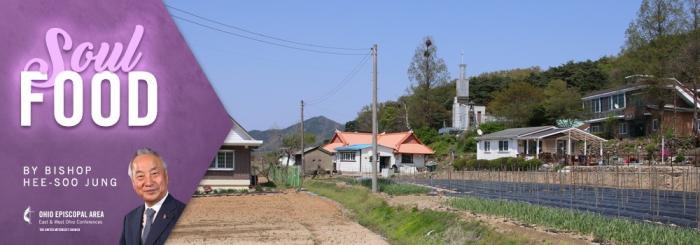
For me, Ganghwa Island is such a place.
In April of 1907, the Rev. William B. Scranton, serving as Presiding Elder, traveled to Ganghwa with missionaries Jones and Deming, along with Rev. No Byung Sun and others, to lead a great Bible conference. Their destination was Jamdu Church, now known as Ganghwa Central Methodist Church.
The record tells us that 320 members of the church came all the way to Gapgot Ferry to welcome the missionary party. They did not merely greet them with polite words. They had prepared a song of welcome, a hymn of love, longing, and gratitude.
They sang:
“Our beloved Jesus has sent our (Presiding) Elder to us.
We waited and longed for him,
and today, at last, we meet.”
And in the refrain:
“He has come, he has come,
our (Presiding) Elder has come.
We waited and hoped,
and today, at last, he has come.”
They sang as they walked from the ferry landing to the church in town. What a holy procession that must have been – Korean believers, new in faith yet overflowing with joy, welcoming those who had come in the name of Christ. This was not only a local church event. It was a sign of God’s mysterious providence.
Only a few years earlier, in 1901, Charles Otto of Marietta, Ohio, gave a special memorial offering in honor of his wife, Lydia. Through that gift, land and buildings were purchased in Ganghwa: a tiled-roof house of 25 rooms and a thatched house of 16 rooms. There, Jamdu Church was established.
A gift from Ohio became a seed of the gospel in Ganghwa. A memorial offering became a mission altar. A family’s love became a church’s foundation.
From that beginning, the Methodist movement in Ganghwa grew with astonishing vitality. Today, the Methodist presence in Ganghwa has expanded into more than 140 churches and four districts. This is not merely institutional growth. It is the fruit of God’s mission, the harvest of sacrifice, prayer, and grace.
The Bible conference of 1907 became a moment of spiritual awakening. So many people came that the church building could not contain them. On the second day, 900 Sunday school children gathered. More than 1,500 believers came from across the whole Ganghwa region. Because there was not enough room, they borrowed Yeonmudang, the military training ground of the Ganghwa garrison, and worshiped in a large outdoor gathering.
That day, 117 people were baptized. Rev. Scranton, overwhelmed by the moment, said with deep emotion, “I am grateful to preach the Word today; and when I think of the old circumstances of the brothers and sisters of Ganghwa, the joy of this day is beyond measure.”
What did he mean by “the old circumstances”?
Ganghwa carried painful memories. In 1866, Korea encountered the armed American merchant ship General Sherman. In 1871, American Naval and Marine forces came demanding the opening of Korea, and a violent conflict followed near Ganghwa. Hundreds of Korean defenders lost their lives. It was a memory of confrontation, fear, and bloodshed.
Yet, only a generation later, American Methodist missionaries came not with weapons, but with the gospel; not to conquer, but to serve; not to demand, but to bear witness to Christ. And the people of Ganghwa came out to the ferry landing singing a welcome song.
What a mystery of reconciliation. What a testimony of grace.
The place, once marked by conflict, became a place of hospitality. The shoreline, once shadowed by confrontation, became a landing place for the gospel. The people, who once faced the West with suspicion, now welcomed missionaries with songs of joy. This is the strange and beautiful work of God.
For Ohio Methodists, this history is not distant. It is deeply personal. Ohio’s missionary heart helped plant seeds in Korea. Through William and Mary Scranton, through gifts such as the memorial offering from Charles Otto of Marietta, through churches and people who believed that “the world is my parish,” Ohio became part of Korea’s gospel story.
And now, by the grace of God, I stand in Ohio as a bishop of the church.
I was born and raised in Ganghwa. It was in Ganghwa that I first came to believe in Jesus. It was there that the seed of the gospel took root in my own life.
How can I not tremble with gratitude?
One hundred and forty years after Ohio helped send the gospel to Korea, a son of Ganghwa has come to Ohio to serve as a bishop. This is not coincidence. This is grace layered upon grace. This is the providence of God weaving history, mission, sacrifice, and calling into one holy story.
When I remember Ganghwa, I remember more than my hometown.
I remember the power of the gospel to heal history.
I remember the courage of missionaries who crossed oceans.
I remember the faith of Korean believers who sang their welcome at the shore.
I remember Ohio’s generosity, planted like a seed in Korean soil.
And I remember that God’s mission never moves in only one direction.
Grace travels.
Grace returns.
Grace remembers.
Grace reconciles.
Grace sends us again.
The story of Ganghwa and Ohio teaches us that mission is never wasted. A gift given in love may become a church. A church may become a movement. A movement may shape generations. And generations later, the fruit of that mission may return with tears of gratitude and a renewed calling.
So today, I give thanks.
Thanks be to God for William and Mary Scranton.
Thanks be to God for the faithful Methodists of Ohio.
Thanks be to God for the saints of Ganghwa who welcomed the gospel with song.
Thanks be to God for the 117 baptized that day, and for the thousands who followed.
Thanks be to God for the healing of history through Jesus Christ.
And may we, the people called Methodists in Ohio today, receive this story not only as history, but as calling.
May we become again a people of holy fire.
May we live again with missionary courage.
May we plant new communities of faith with joy.
May we welcome strangers with songs of grace.
May we believe that every act of love, every gift of faith, every seed of mission, can become part of God’s redeeming story.
For the gospel that came ashore in Ganghwa is still moving. And the God who turned conflict into welcome, memory into mission, and sorrow into song is still at work among us.
Thanks be to God.